The four questions that separate disinfection from wiping
Which product. Registered against what. At what dilution. Kept wet for how long. If a vendor cannot answer all four for a given surface in your building, what is happening on that surface is cleaning, and cleaning is not disinfection.
The gap is almost never bad intent. It is a single all purpose product used for claims its label does not cover, a concentrate poured by eye, and a spray and wipe motion that leaves the surface dry in twenty seconds when the label asks for four minutes.
Cleaning still matters, and it comes first. Organic soil neutralises many active ingredients, so a disinfectant applied over a soiled surface underperforms regardless of dwell time. Clean, then disinfect, then hold the time.
What is actually performed, and what it leaves behind
Every line names its cadence and the document it produces. A task with no artefact is a task nobody can verify.
Disinfection programme
Product matched to the claimSelected from the applicable EPA list for the organism in question. One general purpose product does not cover every claim, and pretending it does is the most common failure in the industry.At scopingApproved product schedule with registration numbers
Dilution through a controlled dispenserWall mounted proportioners rather than free pouring. An under diluted product fails the claim. An over diluted product wastes money and leaves residue.Every fillDispenser calibration record
Surface pre-cleaned where the label requires itMost labels require a clean surface. Organic soil neutralises the active ingredient, so disinfecting over soil is theatre.Every applicationMethod in the SOW
Wet contact time held to the labelThe surface stays visibly wet for the full time. If it dries early, more product goes on. This is the single line most contracts omit and the single line that matters most.Every applicationProduct, dilution and wet time logged
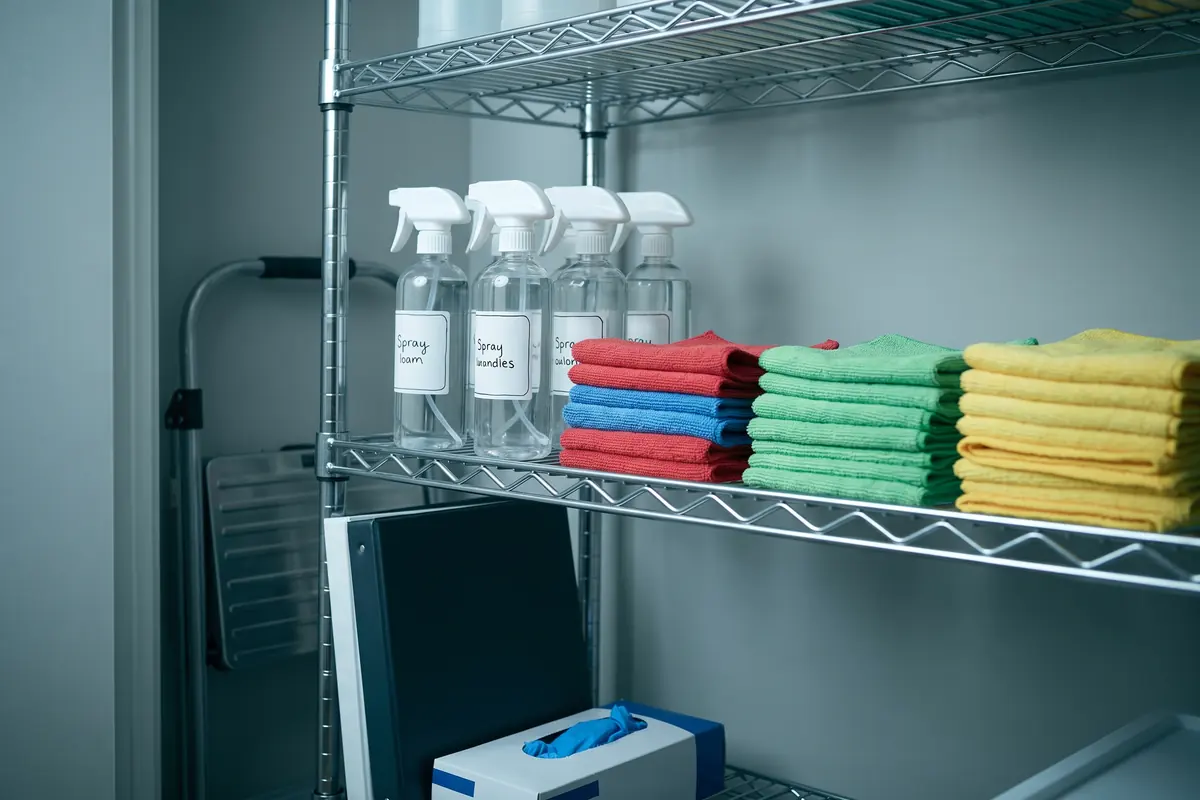
Colour coded microfibre by zoneRed, yellow, blue and green cloths by area, laundered between shifts. A cloth is never rinsed and carried into a different zone.Every shiftColour code chart in the closet
Touch point rounds performedDoor hardware, switches, elevator plates, handrails, shared appliances and shared equipment, on a named round with a time.DailyRound sheet
PPE worn to the labelGloves and eye protection as the product label specifies, not as habit dictates. Some concentrates require more than the diluted solution does.Every applicationPPE hazard assessment per product
SDS available on site and digitallyA physical binder in the janitor closet and a digital index, covering every product physically present in your building.MaintainedSDS index, updated on product change
Typical wet contact times by product chemistry. Always follow the master label.
Chemistry
Common contact time range
Notes
Quaternary ammonium (quat)
3 to 10 minutes
Widely used, low odour, absorbed by cotton so use microfibre. Longer dwell than most people assume.
Accelerated hydrogen peroxide
1 to 5 minutes
Fast, broad spectrum, material compatible with most surfaces. Costs more per gallon and often less per room.
Sodium hypochlorite (bleach)
1 to 10 minutes
Effective against C. diff spores at the right concentration. Corrosive, damages many surfaces, needs ventilation.
Alcohol based, 60 to 90 percent
30 seconds to 1 minute
Evaporates fast, which is exactly why it often fails a longer claim. Good for small electronics.
Phenolic
5 to 10 minutes
Healthcare use with specific restrictions. Not for food contact surfaces or infant care areas.
These are indicative ranges for the chemistry class. The legally binding number is the one on the specific product master label for the specific organism claimed, and it is the only number our technicians work to.
The EPA lists, in plain terms
The EPA registers antimicrobial products and publishes lists organised by pathogen. A product on a list has been reviewed as effective against that organism when used exactly as its label directs.
List N: registered against SARS-CoV-2. The list most commercial scopes reference.
List K: registered against Clostridioides difficile spores. Healthcare and long term care.
List G: registered against norovirus. Food service, education, hospitality.
List H: registered against MRSA and VRE. Healthcare, athletics, fitness.
List B: tuberculocidal products, where a clinical plan requires that claim.
List Q: emerging viral pathogens, used when a novel organism has no dedicated list yet.
Why the surface has to stay visibly wet
The contact time on a label is the tested exposure period. It assumes continuous wet contact between the active ingredient and the surface for the full duration. A surface that dries at ninety seconds into a four minute claim has had ninety seconds of exposure, not four minutes.
In practice this fails constantly. A warm stainless handrail in moving air can flash off in under two minutes. A light misting spray never wets the surface properly in the first place. And a spray and wipe in one motion, which is what most people do, removes the product almost as fast as it goes on.
The fix is unglamorous: apply enough product, apply it to a pre-cleaned surface, walk away, come back, and reapply if it dried. It is slower, which is why it has to be scoped and paid for rather than assumed.
Response disinfection
For contracted accounts we mobilise a response clean within four hours of your call: a confirmed case, an outbreak in a school wing, a contamination event in a clinical space. The affected zone is treated with a product registered for the specific organism, at the label contact time, by technicians briefed on that label.
You receive a written report within 24 hours listing the areas treated, the product and registration number used, the dilution, and the contact time held. It is the document your safety committee or your parents association is going to ask for.
What we will not claim
We do not offer electrostatic fogging as a substitute for wiping surfaces. Fogging can be a useful adjunct for large, awkward spaces when the product is labelled for that application method, but it does not remove soil, and a surface that has not been cleaned has not been disinfected regardless of what was sprayed at it.
We do not use the word sanitised and the word disinfected interchangeably. They are different claims with different testing thresholds, and a facility manager who has been sold one while being charged for the other has a right to be irritated.
Compliance
What every technician on this account has completed
Training is recorded per person with dates, and the roster is part of your monthly pack. A vendor who cannot produce a training record has not delivered the training.
Bloodborne pathogens29 CFR 1910.1030At hire, then annually
Hazard communication and SDS29 CFR 1910.1200At hire, then annually
HIPAA awareness for healthcare accounts45 CFR Parts 160 and 164At hire, then annually
PPE selection and use29 CFR 1910.132At hire, then annually
Powered equipment operationManufacturer certificationBefore first solo use
Questions
About disinfection
Is fogging or electrostatic spraying better than wiping?
It is different, and it is not a replacement. Fogging distributes product across a large area quickly and can reach awkward geometry, which makes it useful in a gymnasium or a large open floor when the product label permits that application method. What it does not do is remove soil, and it does not reliably hold a wet contact time on a vertical or overhead surface. Mechanical wiping of high touch points remains the work.
How do we know the right product is being used?
The approved product schedule is part of your scope of work and it lists the product name, the EPA registration number, the claim it covers and the contact time. Anything not on that schedule does not come into your building. Your account manager verifies it during the monthly inspection, and the SDS binder in the closet is the physical check anyone on your team can perform without notice.
What is the difference between cleaning, sanitising and disinfecting?
Cleaning removes soil and a large proportion of the organisms on a surface with it, mechanically. Sanitising reduces bacteria to a level judged safe by public health standards, and is the claim used on food contact surfaces. Disinfecting kills or inactivates the organisms named on the product label when used at the labelled dilution and contact time. They are three distinct claims and they carry three distinct price points.
Do you disinfect everything every night?
No, and a vendor who says they do is describing an invoice rather than an operation. Full surface disinfection of an entire building nightly is neither achievable in the hours available nor useful. The programme disinfects the surfaces that transmit: touch points, shared equipment, restroom fixtures, food areas. Everything else is cleaned, which is the right treatment for it.
Ninety minutes on site with an account manager and an operations lead. You leave with a measured cleanable square footage, a draft scope of work and a price, in writing, within five business days.