Meridian

Post construction

The last trade on site, and the one nobody plans for

Three phase cleanup for commercial fit outs, ground up builds and tenant improvements, mobilised in 72 hours and scheduled against your certificate of occupancy date.

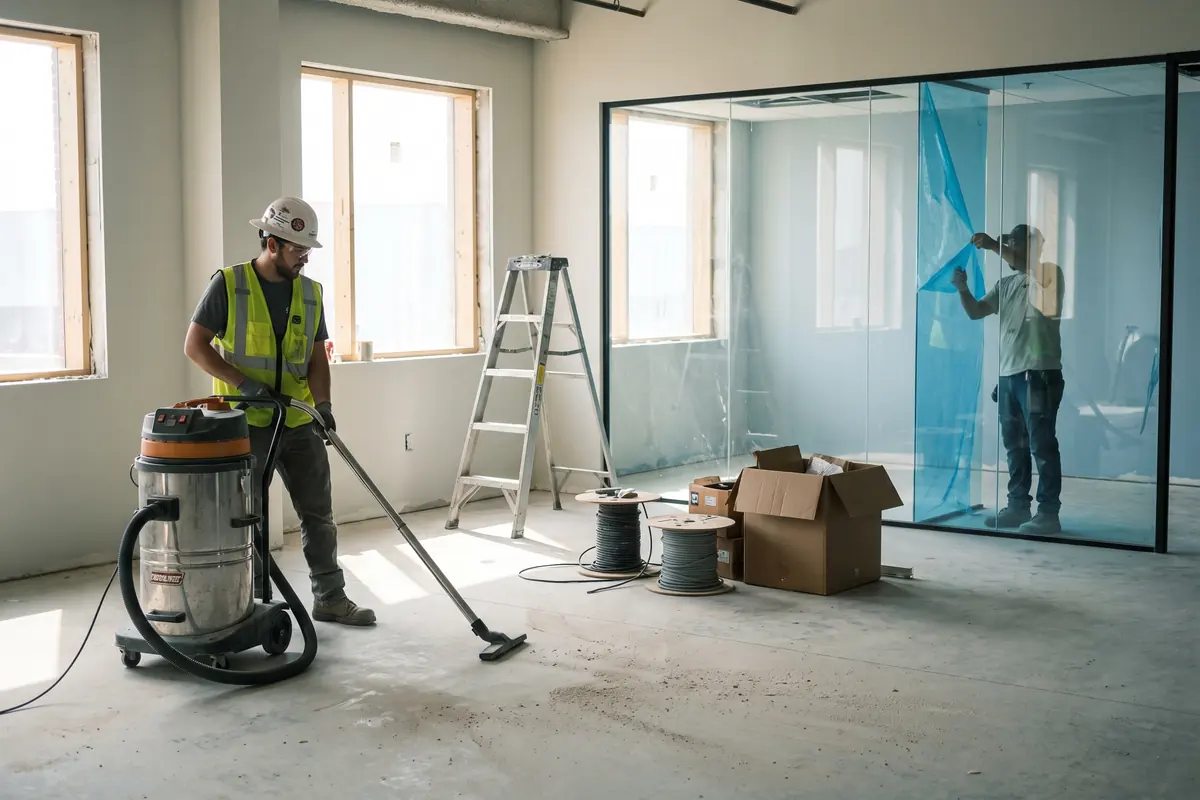
Workers in hard hats removing protective film from window mullions and vacuuming drywall dust in a new office fit out
  • 72hrMobilisation from a signed release
  • 3Phases: rough, final, and touch up
  • 48hrPunch list closed after phase three walk
  • 3-passGlass method: scrape, wash, detail

Construction dust is a schedule risk, not a cleaning job

Drywall dust is fine enough to stay airborne for hours and settles into every horizontal surface, every track, every ceiling grid and every mechanical opening in the building. It is the reason a space that looked finished on Friday looks unfinished on Monday.

The only way to beat it is sequencing. Clean the high surfaces before the low ones, clean before the mechanical system is commissioned rather than after, and accept that some surfaces need touching twice because a trade will be back.

We run three phases against your construction schedule, not against a calendar, and the third phase exists specifically to absorb the trades who come back after you thought they were done.

What is actually performed, and what it leaves behind

Every line names its cadence and the document it produces. A task with no artefact is a task nobody can verify.

Three phase programme

  1. Phase one, rough cleanConstruction debris removed, floors swept and vacuumed, surfaces roughed down. Performed once the space is broom ready and before finishes go in.After framing and rough inPhase sign off
  2. Phase two, ceiling and high surface dustCeiling grid, tiles, diffusers, sprinkler escutcheons, lighting, conduit and any exposed structure, all HEPA vacuumed top down before the floors are touched.Start of final cleanPhase sign off with photographs
  3. Phase two, glass and glazing, three passScrape and remove stickers, film, paint spatter and mortar splash. Wash. Detail edges and frames. Three passes because one never gets construction glass clean.Final cleanPhase sign off
  4. Phase two, millwork, fixtures and hardwareCabinet interiors and drawer boxes, shelving, door hardware, switch and outlet plates, and every horizontal ledge including the tops of door frames.Final cleanPhase sign off
  5. Phase two, floors to finish standardGrout haze removed on tile, protective film lifted from resilient, hard floors machine cleaned and sealed or finished where scoped, carpet extracted.Final cleanPhase sign off with photographs
  6. Phase three, touch up and white gloveThe pass after the trades come back. Fingerprints, scuffs, a re-clean of anything disturbed, and the detail work that only reads at handover.Before occupancyWalkthrough punch list
  7. Punch list closed with the general contractorWalked jointly, itemised, and closed inside 48 hours with photographs against each item.At handoverSigned punch list
  8. Waste removed to your site planOur debris goes into your dumpsters under your waste plan, sorted where your LEED submission requires diversion tracking.OngoingDiversion weights where scoped

Phase sequencing against a typical commercial fit out

PhaseTriggerDuration guideCrew
Rough cleanFraming and rough in complete1 to 2 days per 20,000 sq ft4 to 6
Final cleanAll trades substantially complete3 to 5 days per 20,000 sq ft8 to 14
Touch upAfter punch trades return1 day per 20,000 sq ft3 to 5
Handover walkBefore certificate of occupancySame day2 plus supervisor

Durations assume power, water and lighting are live and the space is weather tight. A final clean run in an unheated shell in February takes materially longer and is priced that way.

Why phase three is not optional

Every fit out ends the same way. The final clean is signed off, and then the electrician comes back for a trim plate, the painter touches up a corner, the flooring contractor fixes a seam, and the millwork installer adjusts a door. Each visit leaves fingerprints, dust and a footprint.

A two phase scope means either the general contractor absorbs that work with their own labour, or the client accepts the building in that condition. A three phase scope prices it once, at the right time, with a small crew.

Site requirements before we mobilise

  • Power and lighting live on the floor, and water available on the floor or one floor below.
  • The space weather tight, with glazing installed and openings closed.
  • Dumpster capacity on site under your waste plan, sized for the phase.
  • A site specific safety orientation slot for our crew before first entry.
  • The trade schedule, so phase two is not booked into a week the painters are still working.

What we bring

HEPA filtered vacuums throughout, because a standard vacuum redistributes fine drywall dust rather than capturing it. Lifts and ladders for high work under your permit process. Window scrapers with new blades per pane, since a reused blade is how construction glass gets scratched and how a cleaning contractor ends up paying for glazing.

Compliance

What every technician on this account has completed

Training is recorded per person with dates, and the roster is part of your monthly pack. A vendor who cannot produce a training record has not delivered the training.

Full compliance detail

  • Bloodborne pathogens29 CFR 1910.1030At hire, then annually
  • Hazard communication and SDS29 CFR 1910.1200At hire, then annually
  • HIPAA awareness for healthcare accounts45 CFR Parts 160 and 164At hire, then annually
  • PPE selection and use29 CFR 1910.132At hire, then annually
  • Powered equipment operationManufacturer certificationBefore first solo use

Questions

About post construction

How quickly can you mobilise?

Seventy two hours from a signed release for a standard commercial fit out, faster for a phase three touch up. What slows a mobilisation is almost never crew availability. It is site orientation slots, badging and confirming that the space is genuinely ready for the phase being booked.

Who is responsible if glass gets scratched?

We are, if our technician did it, and we carry general liability at $2,000,000 per occurrence for exactly that reason. The way to avoid the conversation is method: new scraper blades per pane, blades held at the correct angle, and no scraping on tempered or coated glass without confirming the coating side first. We document glass condition before phase two starts, which protects both parties.

Can you support a LEED submission?

For the construction waste diversion credits, yes, where our debris goes through your tracked stream and the weights are recorded. For indoor air quality during construction, our part is the HEPA vacuuming, the low VOC product selection and the sequencing, all documented. The credit is your project team submission and we supply the evidence for our scope, not the submission itself.

Do you clean during construction as well as after?

Yes, as a separate line. Ongoing construction housekeeping through the build keeps the site safer, keeps trades productive and makes the rough clean substantially cheaper. It is usually two or three visits per week with a small crew and it pays for itself in the phase one number.

Book a walkthrough of your building

Ninety minutes on site with an account manager and an operations lead. You leave with a measured cleanable square footage, a draft scope of work and a price, in writing, within five business days.

DOC BRAND-SPEC-01REV A

Brand specification

Live configuration for this demonstration site. Values apply immediately, persist in this browser, and are carried in the address bar so the exact configuration below can be sent to a colleague as a link.

CL-00Colour set
CL-01Primary

CL-02Secondary

TY-00Typeface

ID-01Business name
ID-02Short form

Used alone in the rail, the mobile bar and running copy. Defaults to the first word of the name.

ID-03Telephone
ID-04Email

The role addresses on the contact and careers pages follow this domain.

ID-05Logo mark

Replaces the monogram in the rail and the footer. Held in this browser only, never in the link.

Demonstration control only. Meridian Facility Services is a fictional company; this panel exists so a prospect can see their own brand on the layout.