Meridian

Floor care

A floor programme, not an annual emergency

Strip and refinish, burnish, scrub and recoat, hot water extraction and hard surface restoration, scheduled 21 days ahead and photographed at the same camera position.

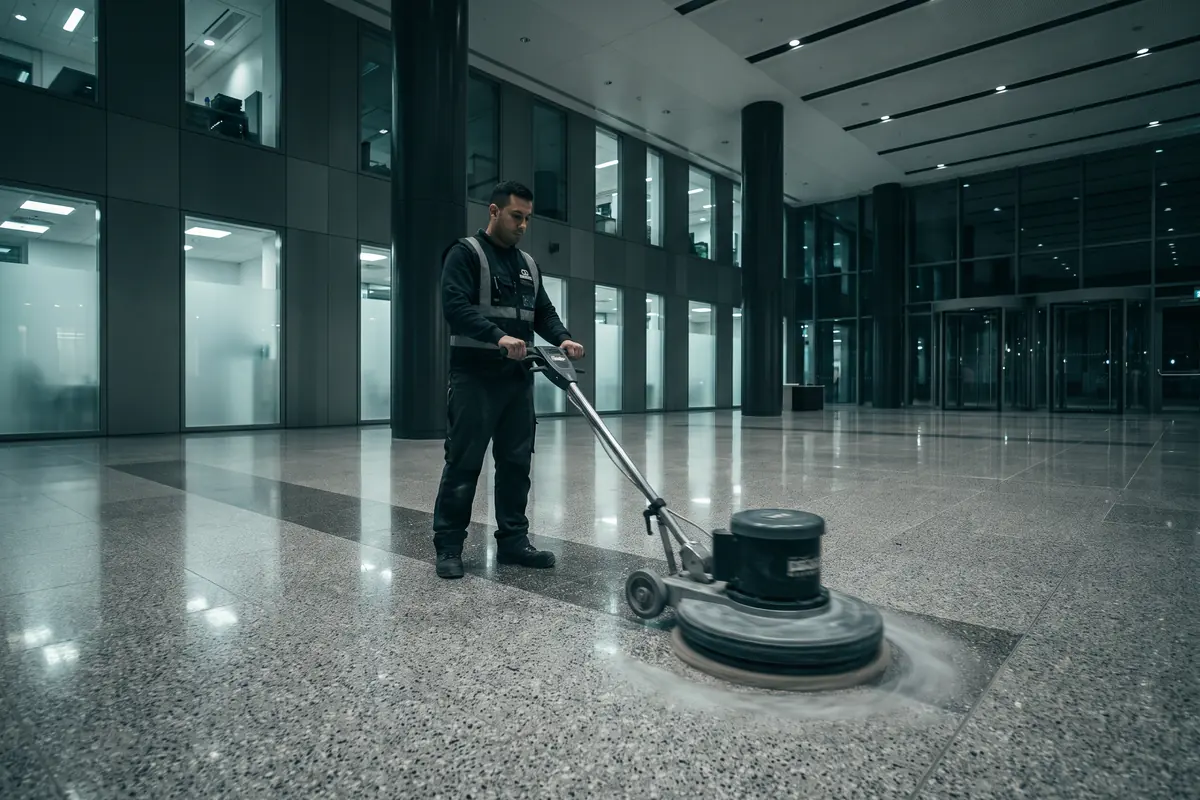
A floor care technician operating a rotary burnisher on polished terrazzo in a corporate lobby at night
  • 5 coatsFinish on a lobby refinish, four in traffic lanes
  • 21 daysWritten notice before any scheduled floor work
  • 1,500+ rpmBurnisher speed for a high gloss maintained finish
  • 3 to 5 yrRealistic strip interval on a maintained floor

Grit is what kills a floor, and matting is what stops grit

A commercial floor almost never fails because of what was spilled on it. It fails because of what was walked onto it. Grit tracked in from the street is abrasive, and every footstep grinds it into the finish.

Which means the highest return floor care spending in most buildings is fifteen feet of proper entrance matting and an honest nightly dust mop, both of which cost almost nothing. Everything above that is restoration of damage that better housekeeping would have prevented.

We schedule floor care on a published calendar so your tenants know, and we photograph before and after from the same camera position so nobody has to argue about whether it happened.

What is actually performed, and what it leaves behind

Every line names its cadence and the document it produces. A task with no artefact is a task nobody can verify.

Hard floor maintenance ladder, cheapest first

  1. Entrance matting maintainedFifteen feet of matting at each entrance, vacuumed nightly and extracted periodically. This is the single cheapest intervention in floor care and it is skipped constantly.NightlyShift log
  2. Dust mop, then damp mopGrit removal before any water touches the floor. Damp mopping over grit turns it into an abrasive slurry and grinds it in.NightlyShift log
  3. BurnishA high speed pad at 1,500 rpm or above restores gloss and hardens the top coats. Frequency follows traffic: weekly in a lobby, monthly in a back corridor.Weekly to monthlyFloor care calendar entry
  4. Spray buffA restorer plus a pad repairs light scuffing and marking without removing coats. Where burnishing alone stops being enough.MonthlyFloor care calendar entry
  5. Scrub and recoatRemoves the top coats without going to the tile, then lays two fresh coats. Most of the visual benefit of a strip at a fraction of the cost and disruption.Quarterly to twice yearlyBefore and after photographs
  6. Strip and refinishAll finish removed to the tile, then rebuilt with four coats in traffic lanes and five in lobbies. Reserved for genuine finish failure, not scheduled out of habit.Every 3 to 5 yearsBefore and after photographs, coat count recorded
  7. Carpet interim maintenanceEncapsulation or bonnet cleaning between extractions keeps traffic lanes from setting, at a fraction of extraction cost and with no drying downtime.QuarterlyFloor care calendar entry
  8. Hot water carpet extractionPre spray, agitate, extract, groom. Scheduled to allow proper drying, with air movers where the space cannot be left overnight.Annually to twice yearlyBefore and after photographs

Surface types and the maintenance they actually want

SurfaceRoutinePeriodicRestoration
VCTDust mop, damp mopBurnish, spray buffScrub and recoat, then strip and refinish
TerrazzoDust mop, neutral damp mopBurnish or polishDiamond honing and polishing, not a wax coat
Polished concreteDust mop, autoscrubDensifier and guard reapplicationRe-polish at grit sequence
LVTDust mop, damp mopMachine scrubManufacturer specific, most LVT should not be waxed
Sealed hardwood, gymDust mop, tacky mopAuto scrub to specScreen and recoat, sand every 8 to 12 years
Ceramic and quarry tileSweep, mopMachine scrub with grout brushDeep grout extraction and reseal
Carpet tileVacuum, spot treatEncapsulationHot water extraction

The most common and most expensive mistake in commercial floor care is applying a wax finish to a surface that should never receive one. Terrazzo, polished concrete and most LVT are in that category.

Strip and refinish: what to require in writing

  • Coat count, stated per area. Four coats in traffic lanes, five minimum in lobbies and entrances.
  • Cure time before the space returns to service, and what happens if the schedule slips.
  • Slip resistance expectation, so nobody hands you a mirror finish nobody can walk on.
  • Edge and corner detail, because the failure is always at the baseboard, never in the middle of the room.
  • Signage and closure plan, with your tenant communication written before the weekend it happens.
  • Before and after photographs from the same camera position, which cost nothing and settle every dispute.

Burnish versus buff, since the terms get used interchangeably

Buffing runs at low speed, typically 175 to 350 rpm, and works with a spray restorer to repair light damage. Burnishing runs at 1,500 rpm and above and uses heat and friction to melt the top of the finish back into a smooth, hard, high gloss surface.

A floor on a burnish programme gets harder over time. A floor that is only ever buffed does not. In a building with a decent matting programme, burnishing is the operation that pushes the strip interval from annual out to three or five years.

Carpet, and the drying problem nobody schedules for

Hot water extraction is the deep clean, and it wets the carpet. Under normal office conditions a properly extracted carpet is dry in four to eight hours with air movers and considerably longer without.

Which is why extraction is a Friday night operation in most buildings, and why interim encapsulation exists. Encapsulation crystallises soil so it can be vacuumed out, dries in under an hour, and keeps traffic lanes from setting between extractions. Running both is cheaper over three years than extracting more often.

Compliance

What every technician on this account has completed

Training is recorded per person with dates, and the roster is part of your monthly pack. A vendor who cannot produce a training record has not delivered the training.

Full compliance detail

  • Bloodborne pathogens29 CFR 1910.1030At hire, then annually
  • Hazard communication and SDS29 CFR 1910.1200At hire, then annually
  • HIPAA awareness for healthcare accounts45 CFR Parts 160 and 164At hire, then annually
  • PPE selection and use29 CFR 1910.132At hire, then annually
  • Powered equipment operationManufacturer certificationBefore first solo use

Questions

About floor care

How often should we strip and wax?

Far less often than most buildings do. On a floor with proper entrance matting, honest nightly dust mopping, a burnish programme and periodic scrub and recoat, a full strip belongs at three to five year intervals. Annual stripping is usually a symptom of a maintenance programme that is not doing its job, and it is hard on the tile as well as your budget.

Can you do floor work without closing the space?

Burnishing and spray buffing, yes, overnight with no impact on the next morning. Scrub and recoat needs the area closed for the coats to lay and set, usually overnight. A full strip and refinish needs a weekend and real cure time before traffic. We schedule 21 days out in writing so you can tell tenants once, properly, rather than three times badly.

What is encapsulation and is it a shortcut?

It is an interim carpet maintenance method, not a replacement for extraction. A polymer is applied and agitated into the pile, it crystallises around soil particles, and the crystals are vacuumed out over the following days. It dries fast, so a space can be used almost immediately. Used between annual extractions it keeps traffic lanes from setting. Used instead of extraction it eventually leaves residue behind.

Our terrazzo lobby looks dull. Do we need to wax it?

Almost certainly not, and applying a wax finish to terrazzo is a decision that costs a lot to reverse. Terrazzo is a hard stone surface that is restored by diamond honing and polishing to bring the surface back mechanically. Once someone puts a coat of finish on it you are committed to maintaining that coat, and stripping it back off terrazzo later is slow, expensive work.

Book a walkthrough of your building

Ninety minutes on site with an account manager and an operations lead. You leave with a measured cleanable square footage, a draft scope of work and a price, in writing, within five business days.

DOC BRAND-SPEC-01REV A

Brand specification

Live configuration for this demonstration site. Values apply immediately, persist in this browser, and are carried in the address bar so the exact configuration below can be sent to a colleague as a link.

CL-00Colour set
CL-01Primary

CL-02Secondary

TY-00Typeface

ID-01Business name
ID-02Short form

Used alone in the rail, the mobile bar and running copy. Defaults to the first word of the name.

ID-03Telephone
ID-04Email

The role addresses on the contact and careers pages follow this domain.

ID-05Logo mark

Replaces the monogram in the rail and the footer. Held in this browser only, never in the link.

Demonstration control only. Meridian Facility Services is a fictional company; this panel exists so a prospect can see their own brand on the layout.