Meridian

Medical facilities

Cleaning that holds up at your annual survey

Routine and terminal cleaning for ambulatory surgery centres, dental groups, imaging suites, dialysis and physician practices, with contact times logged per round.

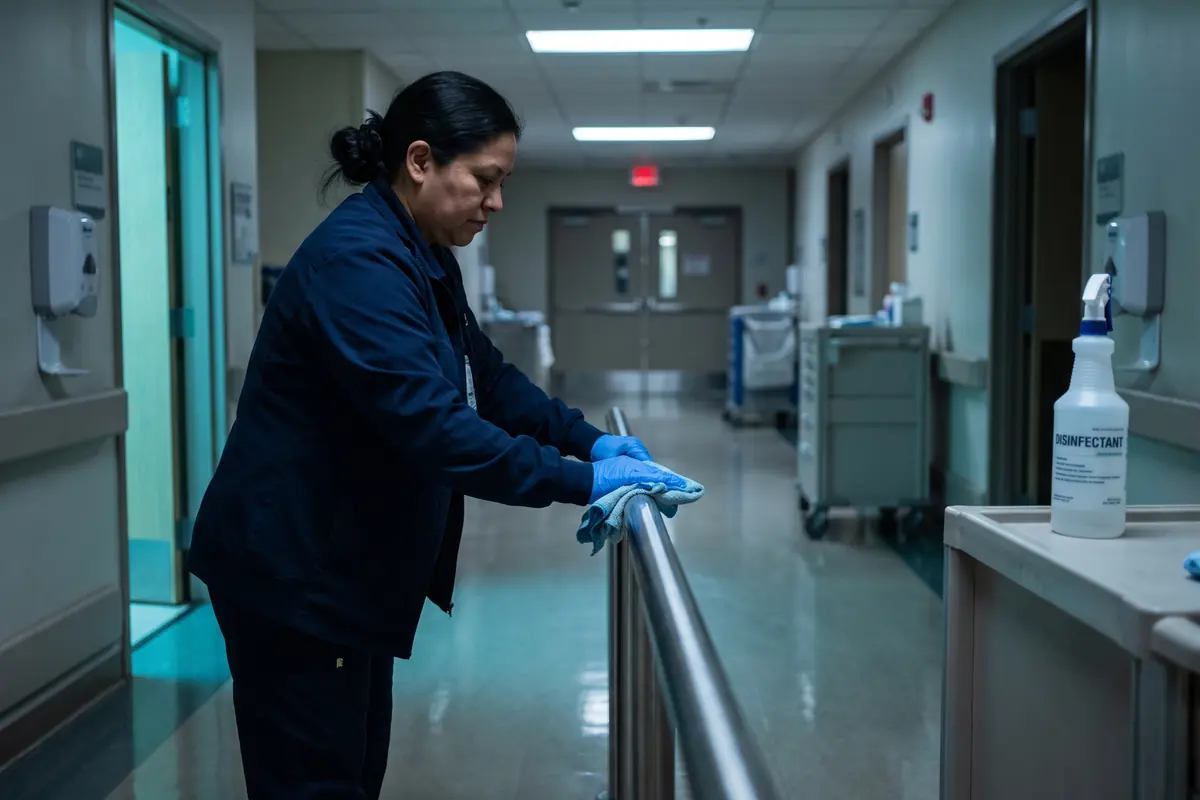
A technician in nitrile gloves disinfecting a stainless handrail in a hospital corridor at night
  • 2hrResponse window for a contamination event
  • 12moContact time logs retained and available
  • 100%Named technicians, no floating pool
  • 1030OSHA bloodborne pathogen standard, trained annually

Environmental cleaning is a survey finding waiting to happen

In a healthcare setting cleaning is not a facilities line item. It is part of your infection prevention programme, and your surveyor treats it that way. The questions are specific: which product, registered against what, at what dilution, kept wet for how long, and where is the log.

A janitorial vendor who cannot answer those four questions on the spot is a risk your infection preventionist is carrying on your behalf.

We train technicians on the specific product labels present in your building, not on cleaning in general. Colour coded microfibre prevents cross contamination between zones. Contact times are logged per round. Nobody works a medical account until they have completed bloodborne pathogen and HIPAA awareness training and cleared a background check.

What is actually performed, and what it leaves behind

Every line names its cadence and the document it produces. A task with no artefact is a task nobody can verify.

Medical facility programme

  1. Zone specific colour coded microfibreRed for restrooms and contaminated zones, yellow for clinical surfaces, blue for general and glass, green for food areas. Cloths are laundered, never rinsed and reused within a shift.Every shiftColour code chart posted in the closet
  2. Exam and treatment room routine cleanHorizontal surfaces, exam table, cabinetry fronts, stools, touch points and floor, in a top to bottom, clean to dirty order.Daily or between casesRoom log
  3. Terminal clean performed to protocolFull room including walls to splash height, all equipment surfaces, curtains changed where scoped, floor edge to edge. Performed after an isolation case or at close per your infection control plan.Per protocolTerminal clean record signed off
  4. Disinfectant contact time heldProduct selected from the applicable EPA list for the claim, dilution controlled, surface kept visibly wet for the full time on the master label, reapplied if it dries.Every applicationProduct, dilution, wet time logged
  5. Sharps and regulated waste protocol observedTechnicians do not handle sharps containers beyond the scope agreed with your safety officer. Regulated medical waste is your licensed hauler, never the janitorial crew.Every shiftWritten protocol in the SOW
  6. Waiting areas and public restrooms servicedSeating, toys and shared surfaces disinfected, restrooms fully serviced, entrance glass and mats maintained.Daily, plus porter roundsRound log
  7. Floors maintained without disrupting clinic hoursNightly damp mop, periodic machine scrub, and any refinish scheduled around your surgery calendar with written notice.Nightly and scheduledFloor care calendar
  8. HIPAA awareness observed on every shiftTechnicians are trained on minimum necessary and incidental disclosure. Paper left on a desk is not read, not moved off the desk, and not photographed.Annual trainingTraining record per technician

EPA antimicrobial product lists referenced in healthcare scopes

ListRegistered againstTypical use in a clinical setting
List NSARS-CoV-2General clinical and public surface disinfection
List KClostridioides difficile sporesRooms and equipment under a C. diff protocol
List GNorovirusOutbreak response, waiting areas, restrooms
List HMRSA and VRETreatment surfaces, shared equipment, therapy areas
List BMycobacterium tuberculosisWhere your plan calls for a tuberculocidal claim

Product selection is agreed with your infection preventionist and named in the scope of work. Contact times always follow the product master label, never a house rule.

Terminal versus routine, and why the distinction is billable

A routine clean addresses the surfaces used during normal operation: horizontal surfaces, touch points, the exam table, the floor. It is fast, it is scheduled, and it is priced per room per day.

A terminal clean assumes the room is contaminated. Everything is treated: walls to splash height, all equipment surfaces, fixtures, the full floor edge to edge, and anything removable is removed. It takes three to five times as long and it is priced per event.

A vendor who quotes you a flat per room rate without asking how many terminal cleans you run per month has either not understood the building or has priced routine work and will renegotiate. Ask which one it is before you sign.

What we do not do

  • We do not handle regulated medical waste. That is your licensed hauler, under your generator number.
  • We do not touch sterile processing instruments or reprocessing equipment.
  • We do not enter a room under active isolation without your clearance and the PPE your protocol specifies.
  • We do not move or read patient paperwork. If it is in the way, it stays in the way and gets noted.
  • We do not clean around a biohazard spill. It is escalated and remediated under a separate protocol.

Staffing a medical account

The same two or three named technicians work your building every night, cleared before their first shift with a background check, E-Verify, bloodborne pathogen training, HIPAA awareness and site specific orientation. Substitutes come from a small pre-cleared bench, not from whoever is available.

This costs more than a floating pool and it is not negotiable on a medical account. A technician who knows where your sharps containers live and which door is the clean corridor is worth several times a technician who does not.

Compliance

What every technician on this account has completed

Training is recorded per person with dates, and the roster is part of your monthly pack. A vendor who cannot produce a training record has not delivered the training.

Full compliance detail

  • Bloodborne pathogens29 CFR 1910.1030At hire, then annually
  • Hazard communication and SDS29 CFR 1910.1200At hire, then annually
  • HIPAA awareness for healthcare accounts45 CFR Parts 160 and 164At hire, then annually
  • PPE selection and use29 CFR 1910.132At hire, then annually
  • Powered equipment operationManufacturer certificationBefore first solo use

Questions

About medical facilities

Do your staff need to be on our HIPAA training programme?

They complete HIPAA awareness training annually as part of our own programme, and we provide the records. Most clients also run their own site specific orientation, which we build into the mobilisation schedule. If your compliance officer wants technicians on your learning management system instead, we will do it that way. What matters is that the record exists and you can produce it.

How do you prove a contact time was actually held?

The technician logs the product, the dilution and the wet contact time per round, and the supervisor spot checks against the label during the weekly inspection. The logs are retained for twelve months and are available to your infection preventionist on request. It is not a perfect proof, because nothing short of a camera is, but it is a record that stands up to a survey question and it changes behaviour.

Can you work around our surgery schedule?

Yes, and we plan around it rather than reacting to it. Routine cleaning is scheduled against your case calendar, terminal cleans are called in as they arise inside the response window in your SLA, and floor care is scheduled with written notice in a window your surgical schedule allows. For a busy ambulatory surgery centre that usually means overnight plus a small daytime presence.

What happens if a technician is exposed to blood or body fluid?

Our exposure control plan takes over. The technician stops work, follows the post exposure protocol under 29 CFR 1910.1030, and the incident is reported to your safety officer the same shift. You receive a written report within 24 hours. The plan is in the mobilisation pack, so you can read it before it is needed rather than during.

Book a walkthrough of your building

Ninety minutes on site with an account manager and an operations lead. You leave with a measured cleanable square footage, a draft scope of work and a price, in writing, within five business days.

DOC BRAND-SPEC-01REV A

Brand specification

Live configuration for this demonstration site. Values apply immediately, persist in this browser, and are carried in the address bar so the exact configuration below can be sent to a colleague as a link.

CL-00Colour set
CL-01Primary

CL-02Secondary

TY-00Typeface

ID-01Business name
ID-02Short form

Used alone in the rail, the mobile bar and running copy. Defaults to the first word of the name.

ID-03Telephone
ID-04Email

The role addresses on the contact and careers pages follow this domain.

ID-05Logo mark

Replaces the monogram in the rail and the footer. Held in this browser only, never in the link.

Demonstration control only. Meridian Facility Services is a fictional company; this panel exists so a prospect can see their own brand on the layout.